Inside a Supercar’s Logic

Declan Kennedy
| 05-03-2026
 · Automobile team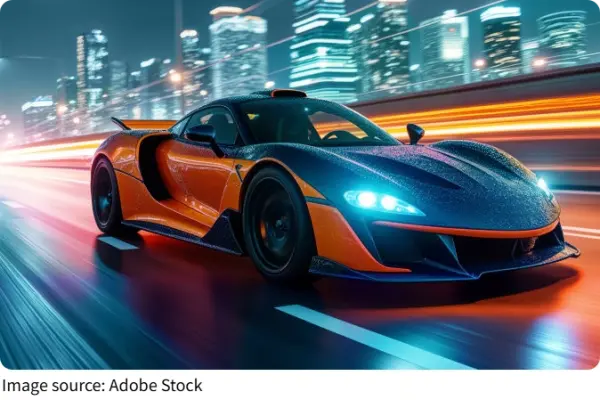
The sound arrives before the car does. A sharp mechanical crescendo builds as it exits a corner, tires gripping, engine climbing toward redline.
For a few seconds, everything seems effortless—speed, balance, precision.
Yet beneath that drama lies something far more methodical. A high-performance supercar is not simply built to go fast; it is engineered around a tightly integrated logic where power, aerodynamics, and chassis tuning work as a unified system.
Understanding that system requires looking beyond horsepower figures and focusing on how each engineering decision supports the others.
Power: More Than Raw Output
1. Power-to-Weight Ratio
In performance engineering, acceleration is influenced as much by mass as by engine output. A car producing 500 horsepower weighing 1,400 kilograms often feels more responsive than a heavier car with similar power. This is why manufacturers use lightweight materials such as aluminum, carbon fiber composites, and magnesium components. Reducing mass improves acceleration, braking, and cornering simultaneously.
2. Torque Delivery and Responsiveness
Horsepower defines peak output, but torque delivery shapes real-world driving feel. Naturally aspirated engines often provide linear throttle response, while turbocharged systems deliver higher torque at lower revolutions. Engineers calibrate throttle mapping carefully to avoid abrupt surges that might unsettle the chassis during corner exit.
Modern high-performance vehicles increasingly adopt hybrid-assisted systems to enhance low-speed torque while maintaining top-end performance. The integration must be seamless; any delay or inconsistency can disrupt driver confidence.
3. Thermal Management
Sustained performance generates heat. Cooling systems—radiators, intercoolers, oil coolers—are strategically placed to maintain optimal operating temperatures. Without precise thermal control, power output declines, and component durability suffers. Airflow management for cooling is therefore inseparable from aerodynamic design.
Aerodynamics: Managing Air as a Structural Force
1. Downforce vs Drag
At high speeds, air behaves like a fluid pressing against the vehicle's surfaces. Engineers design bodywork to generate downforce—vertical pressure that increases tire grip—without creating excessive drag that limits top speed.
Front splitters, rear diffusers, and carefully shaped underbodies accelerate airflow beneath the car, lowering pressure and pulling the chassis toward the ground. Some designs can generate substantial downforce at speed, improving stability and grip—but the exact number varies widely by model and setup.
Performance Racing Industry quotes aerodynamicist Lucas: “Aerodynamic balance is key to making people go faster.”
2. Active Aerodynamics
Many modern sports cars incorporate adjustable rear wings or variable flaps. These systems can change angle depending on speed and braking input, helping balance straight-line efficiency and cornering stability. Active rear spoilers are widely used to deploy at higher speeds when extra downforce is needed.
3. Stability at Speed
Aerodynamics also influence directional stability. Small design changes in side mirrors, air intakes, or wheel arches can reduce turbulence. Even the shape of headlights may be optimized to guide airflow smoothly along the body.
Wind tunnel testing and computational fluid dynamics simulations are essential tools. The goal is not aesthetic aggression but controlled airflow behavior.
Chassis Tuning: Translating Power to the Road
1. Suspension Geometry
The suspension system determines how tires maintain contact with the road during acceleration, braking, and cornering. Double wishbone or multi-link setups allow precise control over camber and toe angles. Engineers tune these parameters to maximize grip while maintaining predictability.
Adaptive dampers further refine performance by adjusting stiffness in real time. On smooth track surfaces, firmer settings reduce body roll. On uneven roads, softer settings preserve stability.
2. Weight Distribution and Balance
Mid-engine layouts position the engine closer to the center of gravity, often achieving near 50:50 front-to-rear weight distribution. This configuration enhances rotational agility in corners. However, balance must be carefully managed to prevent oversteer at high speeds.
Low center of gravity also reduces body movement during rapid direction changes. Battery placement in hybrid supercars is often used strategically to optimize weight distribution.
3. Steering and Feedback
Precise steering calibration is critical. Electric power steering systems are tuned to deliver accurate feedback while minimizing artificial filtering. In high-performance applications, even minor latency in steering response can compromise driver control.
Braking systems complement steering precision. Large ventilated discs—sometimes carbon-ceramic—are designed to handle repeated high-energy stops. Brembo notes that carbon-ceramic (CCM) discs are hard to deform under repeated thermal stress, which is a key reason they’re used in demanding applications.

The Integrated Engineering Philosophy
A high-performance supercar succeeds only when these systems operate cohesively. Increasing engine output without improving aerodynamics may lead to instability. Adding downforce without adjusting suspension geometry can overload tires. Each component influences the others.
Track testing validates this integration. Engineers collect telemetry data on tire temperature, suspension travel, and aerodynamic load distribution. Adjustments follow an iterative process—small calibration changes refined over thousands of test kilometers.
What appears dramatic from the outside is, in reality, a study in balance. Speed alone does not define excellence. Stability at 250 kilometers per hour, precise steering input through a fast corner, and consistent braking performance after repeated laps—these qualities reflect disciplined engineering rather than spectacle.
The next time a supercar accelerates past with a surge of controlled force, consider the invisible calculations behind that moment. Every intake vent, suspension arm, and aerodynamic surface exists for a reason. True performance is not chaos amplified; it is precision executed at the edge of physics.