Curve Driving Mastery

Mariana Silva
| 17-04-2026
 · Automobile team
Mountain roads are where real driving skills are tested. Sharp turns, blind corners, changing road surfaces, and sudden slopes all require calm thinking and precise control.
In this guide, we focus on practical methods we can use in everyday driving. No special upgrades are needed. Only better habits, clearer awareness, and smoother control of speed and direction.
We will learn how to observe the road, prepare the vehicle, handle different curve types, and stay stable in special conditions like night driving or low-visibility areas.
Before the Curve: Preparation and Awareness
Before entering any curve, we need to build strong visual awareness. We should switch our focus between nearby road surfaces and the distant road shape ahead. This helps us understand how sharp the turn is.
We also observe the outer edge of the mountainside. The shape of the terrain often reveals the real curve radius earlier than the road itself.
Road clues are also important. Dark skid marks may suggest frequent hard braking areas. Small rubber particles can show where vehicles often struggle with grip. Trees leaning to one side may hint at wind pressure or ground shifts.
Inside the vehicle, we prepare for stability. We maintain steady tire pressure and choose a driving mode that improves control. In longer winding sections, a stable driving setting helps reduce sudden changes in movement. We also adjust mirrors and clean the windshield area to improve visibility.
Basic Driving Line and Route Strategy
A smooth curve is often based on an outside-inside-outside path. Before entering the curve, we stay slightly toward the outer side to expand our view. At the center of the curve, we move closer to the inner edge. After passing the midpoint, we gently return toward a straight path.
This method helps reduce steering stress and improves stability.
We also pay attention to escape areas along mountain roads. Some roads include designated emergency spaces marked by signage. Recognizing them early allows us to react calmly if unexpected situations occur.
Handling Different Curve Types
Blind curves require extra caution. We slow down before entering and keep speed low enough to react safely. Short, gentle horn signals can help alert others in the area. We also avoid sudden steering changes and keep both hands steady.
For connected curves, rhythm is key. We do not rush out of the first curve. Instead, we prepare early for the next one by observing the angle between them. A smooth transition helps prevent oversteering or understeering.
On wet surfaces, grip becomes limited. We avoid sudden acceleration or sudden slowing. Gentle speed control is more effective. We also avoid areas where water collects, as these sections reduce tire contact with the road.
If the vehicle begins to slide slightly, we do not panic. We gently guide the steering in the direction of movement and allow speed to decrease naturally.
Core Control: Steering, Speed, and Balance
Steering should always be smooth and progressive. Quick repeated adjustments can reduce stability. Instead, we turn gradually, hold steady through the curve, and return slowly when exiting.
Speed control is even more important. We complete most slowing before entering the curve. Inside the curve, we maintain steady speed. After exiting, we gently increase speed again.
Engine control can also help on long downhill sections. Lower gear settings help maintain natural resistance, reducing the need for constant braking.
Body balance also matters. We remain relaxed but stable in the seat, keeping movements minimal. Cargo should be placed centrally to avoid imbalance during turns.
Night and Low-Visibility Conditions
At night, lighting becomes essential. We switch to appropriate lighting before entering curves to avoid disturbing other road users. In low-visibility areas, fog lights can help improve side awareness.
We also read road reflections carefully. Continuous bright reflections may indicate moisture on the surface, which means we should reduce speed early.
In natural roadside environments, we stay alert for sudden movement near the road edges. Slower speed allows more reaction time.
Special Road Situations
In roadwork areas, we follow guidance markers carefully. Traffic cones and signs usually indicate lane direction changes. Narrowing cone spacing often means tighter curves ahead.
In low-visibility fog zones, we increase following distance and rely on lighting systems for guidance. If visibility becomes too low, stopping in a safe area is the best choice.
When driving different vehicle types, we adapt accordingly. Front-wheel vehicles benefit from smooth throttle control. Rear-wheel vehicles require extra caution during acceleration in curves. Larger vehicles need more attention to balance due to higher centers of mass. Electric vehicles require stable energy recovery settings to avoid sudden speed changes in curves.
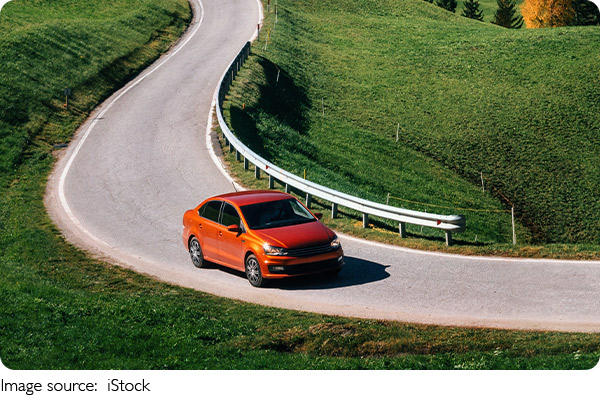
Mastering Curves with Calm Control
In the end, curve driving is not about speed. It is about balance, timing, and awareness. We guide our direction with vision, manage movement with smooth steering, and control stability through careful speed adjustment.
Lykkers, when we respect the road and stay patient, curves stop feeling dangerous. They become a natural flow of movement. The goal is simple: arrive safely, confidently, and smoothly every time we drive.